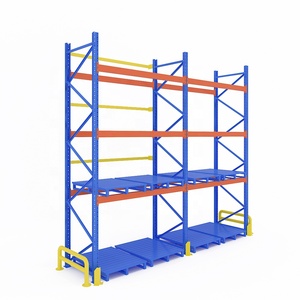
Engineered Industrial Pallet Racking Systems
Explore high-density, certified heavy-duty storage configurations designed for global distribution hubs and modern automated logistics infrastructure.
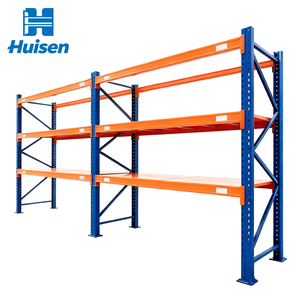
Modern High Density Storage Heavy Duty Pallet Rack for Industrial Warehouse Safety
View Product Details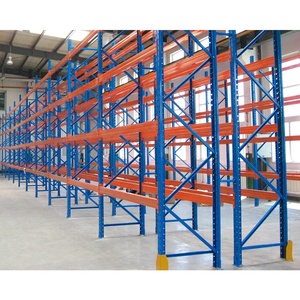
Customized Pallet Rack for Warehouse with Rack Safety Safeguards
View Product Details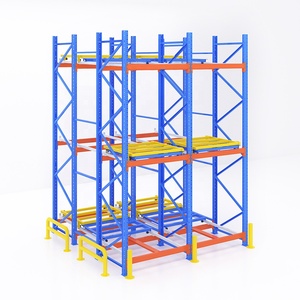
Pallet Live Rack & Heavy-Duty Push Back Storage System
View Product Details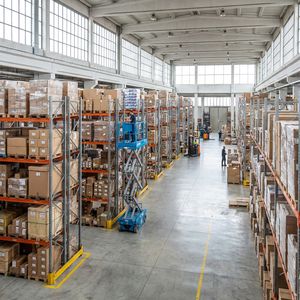
Professional Heavy Duty Pallet Rack System Manufacturer
View Product Details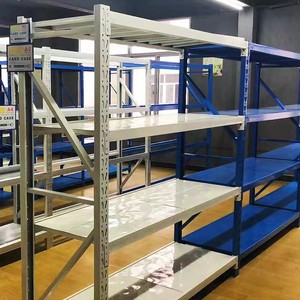
Warehouse Stacking Heavy Industrial Metal Storage Racking
View Product Details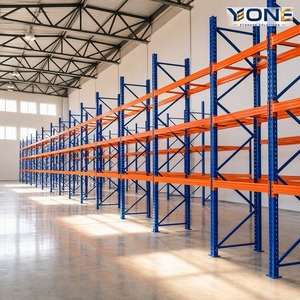
Selective Q235B Cold-Rolled Industrial Steel Racking System
View Product Details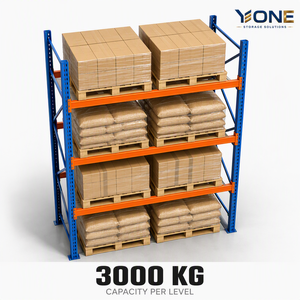
Factory Heavy Duty Steel Pallet Rack (2000kg/Layer Boltless Adjustable)
View Product DetailsQ355B
High-Tensile Steel Grade
50,000+
Tons Annual Output
5,000 KG
Max Layer Load Capacity
ISO/CE/RMI
Certified Quality Compliance
Chapter 1: The Strategic Imperative of Sourcing Industrial Pallet Racking from China
In modern intra-logistics, industrial pallet racking systems serve as the structural backbone of global supply chains. As international commerce accelerates and corporate real estate costs escalate, logistics managers, warehouse operators, and third-party logistics (3PL) providers are under increasing pressure to maximize cubic volumetric storage efficiency. Sourcing structural steel storage racks directly from premier Chinese manufacturers has shifted from a mere cost-saving tactic to a core strategic advantage. China has established an unassailable ecosystem combining advanced metallurgy, automated cold roll-forming technology, continuous powder-coating lines, and end-to-end quality assurance certified under global standards such as FEM, RMI, and AS4084.
When selecting China's best pallet racking industrial suppliers and wholesalers, enterprise buyers acquire access to highly scalable manufacturing infrastructures capable of processing tens of thousands of structural steel tons per month. More importantly, top-tier Chinese vendors integrate Finite Element Analysis (FEA) computer modeling, strict raw material traceability (utilizing certified Q235B and Q355B structural steel grades), and customizable modular rack geometry. This whitepaper serves as an authoritative procurement guide, dissecting structural engineering dynamics, material science benchmarks, manufacturing compliance, future automation trends, and supply chain risk mitigation protocols.
Information Gain Insight: Structural steel selection dictates the long-term total cost of ownership (TCO) in warehouse management. Premium Q355B cold-rolled steel offers a higher yield strength ($\ge 355\text{ MPa}$) compared to standard mild steel ($\ge 235\text{ MPa}$), allowing up to 20% weight reduction without compromising load capacity or seismic resistance.
Chapter 2: Metallurgy, Roll-Forming Precision, and Structural Engineering Standards
The structural reliability of heavy-duty industrial pallet racking depends on three structural pillars: raw steel metallurgy, the geometric profile of roll-formed uprights/beams, and protective surface treatments. Lower-grade storage solutions often suffer from micro-cracking during cold forming or premature deflection under full static/dynamic loads. Leading Chinese enterprise manufacturers enforce rigorous material selection and computerized manufacturing protocols.
1. Metallurgy & Material Physics: Q235B vs. Q355B Structural Steel
Steel grade selection dictates elastic modulus, yield strength, and structural ductility under operational impacts. China’s top racking foundries utilize cold-rolled structural sheet steel sourced directly from tier-1 steel mills (such as Baosteel, Shougang Group, and Ansteel). The structural characteristics are outlined below:
- Q235B Grade Steel: Equivalent to ASTM A36 or EN10025 S235JR. It provides an optimal balance between ductility and tensile strength ($370\text{--}500\text{ MPa}$), making it ideal for standard beams, wire mesh decking, diagonal bracing, and light-to-medium frame profiles.
- Q355B Grade Steel: Equivalent to ASTM A572 Grade 50 or EN10025 S355JR. Delivering an elevated yield strength ($\ge 355\text{ MPa}$), Q355B is selected for ultra-heavy upright columns, Very Narrow Aisle (VNA) systems, and Automated Storage and Retrieval Systems (AS/RS) where high structural rigidity is mandatory.
2. Cold Roll-Forming Profile Geometry & Punching Precision
The column profile design defines resistance to torsional-flexural buckling. High-precision continuous roll-forming machine lines shape steel strips through multiple rolling passes to ensure minimal residual material stress. Column uprights feature multi-surface folding profiles (often incorporating 8 to 16 bending planes) to increase moment of inertia along both primary axes ($I_x, I_y$). Key hole-pitch designs include 50mm, 75mm, and 76.2mm teardrop or diamond punching, engineered with automated CNC punching presses achieving tolerances within $\pm 0.1\text{mm}$.
| System Type | Typical Load Capacity per Level | Aisle Width Requirement | Direct Selectivity | Primary Industrial Application |
|---|---|---|---|---|
| Selective Pallet Racking | 1,000 kg – 4,500 kg | 3.5m – 4.2m (Standard Reach) | 100% Direct Access | FMCG, General Logistics, Multi-SKU Warehouses |
| Very Narrow Aisle (VNA) | 1,500 kg – 3,500 kg | 1.5m – 1.8m (VNA Truck/Guide Rail) | 100% Direct Access | High-Density Distribution Centers, Pharmaceutical |
| Drive-In / Drive-Through | 1,000 kg – 2,000 kg | High Density (LIFO/FIFO Lanes) | 15% – 20% Selective | Cold Storage, Beverage, Seasonal Bulk Goods |
| Push-Back Pallet Racking | 1,000 kg – 1,500 kg per cart | Medium (Nested Trolleys 2–6 Deep) | LIFO per Lane | Buffer Storage, Cold Chains, Food Processing |
| Radio Shuttle Automation | 1,500 kg – 2,000 kg | Automated Fleet Channeling | High Density FIFO/LIFO | Automated High-Bay Logistics, Agro-Exports |
Chapter 3: Deep Technical Evaluation of Industrial Racking Architectures
To optimize spatial utilization without compromising facility safety, warehouse engineers must evaluate structural racking systems based on operational workflows, stock rotation requirements, and pallet handling equipment. China's top tier suppliers manufacture a broad spectrum of structural racking configurations engineered for specialized material handling scenarios:
A. Heavy-Duty Selective Pallet Racking
Selective pallet racking remains the most widely deployed structural storage configuration across global logistics hubs. Engineered with vertical upright frames interconnected by horizontal roll-formed box beams, selective racking provides unhindered 100% access to every individual pallet location. Beams utilize welded 3-claw or 4-claw connector hooks fitted with automatic safety lock pins to prevent accidental dislodgement during forklift lifting operations. Beam deflection ratios are strictly maintained within $L/200$ to $L/300$ of the clear span length under full design load, adhering to EN 15512 standards.
B. Very Narrow Aisle (VNA) Racking Systems
VNA racking modifies selective rack geometry by compressing aisle spaces from traditional 3.5-meter clearance down to as little as 1.5 meters. Operating in conjunction with specialized VNA turret trucks or wire-guided reach trucks, VNA systems unlock up to 40% additional vertical volumetric space. Crucial structural add-ons include floor-anchored steel guide rails or inductive under-floor wire guidance systems, as well as ultra-flat tolerance baseplates engineered to withstand concentrated vertical wheel pressures.
C. High-Density Drive-In & Drive-Through Systems
Drive-In racking eliminates traditional fork-truck access aisles by allowing forklifts to physically enter the storage matrix to deposit or retrieve pallets resting on continuous side-cantilever support rails. Operating on Last-In, First-Out (LIFO) or First-In, First-Out (FIFO) principles, Drive-In systems excel in cold storage environments where high thermal density lowers energy costs per pallet position. Structural bracing modules—including top sway bracing, back horizontal bracing, and heavy-duty floor-anchored column guards—are paramount to absorb dynamic impact loads during fork-truck entry.
D. Automated Four-Way Radio Shuttle & AS/RS Racking
The modern frontier of industrial warehouse automation combines precision-engineered structural racking with self-powered robotic radio shuttles. Four-way radio shuttle systems travel autonomously within storage channels beneath pallets to lift and transport goods to the picking face. AS/RS structural racking demands stringent manufacturing tolerances: beam verticality within $\pm 2\text{mm}$ over 20-meter heights, structural stiffness designed under FEA finite-element seismic acceleration forces, and specialized sensor-reflective powder coating to ensure seamless optical positioning by automated crane systems.
Chapter 4: Manufacturing Capabilities, Quality Assurance & E-E-A-T Rigor
Enterprise credibility (E-E-A-T: Experience, Expertise, Authoritativeness, and Trustworthiness) is verified through transparent production methodologies, factory certifications, and rigorous structural testing routines. When auditing Chinese industrial pallet racking manufacturers, enterprise buyers should look for specific engineering infrastructure capabilities:
Continuous FEA Structural Testing
Utilizing advanced Finite Element Analysis software, engineering teams simulate static load distribution, frame sway dynamics, dynamic forklift collisions, and seismic acceleration forces to ensure compliance with AS4084, FEM 10.2.02, and RMI standards.
Automated Robotic Welding
Critical beam connector hooks and baseplate attachments are executed using multi-axis ABB or FANUC robotic welding cells. Automated CO2 gas-shielded welding guarantees 100% weld penetration without human error or thermal stress deformation.
Thermosetting Powder Coating
Components undergo an automated 7-stage pre-treatment wash (degreasing, phosphating, and deionized water rinsing) prior to electrostatic application of epoxy-polyester powder coat ($60\text{--}90\,\mu\text{m}$ thickness), delivering salt-spray resistance exceeding 500 hours.
Chapter 5: Global Logistics Procurement Trends & Future Outlook (2025–2030)
As global distribution network design evolves, procurement strategies for industrial warehouse racking are undergoing significant transformations. Wholesalers, logistics real estate developers, and plant managers must align their purchasing models with several emerging industry macro-trends:
1. Shift Toward Modular & High-Density Automation Integration
Traditional manual selective storage layouts are increasingly being retrofitted or replaced by modular systems designed for robotic automation. Modern Chinese manufacturers are pre-engineering column uprights and beam profiles with integrated wire-ways, sensor brackets, and shuttle rails. Buying pre-compatible automated infrastructure allows facility operators to phase in automation without tearing down existing steel structures.
2. Seismic Engineering & Environmental Compliance
Global logistics facilities located along seismic zones (such as the Pacific Rim or Southern Europe) demand racking systems certified for dynamic earthquake performance. Modern structural designs incorporate enlarged baseplates, heavy-duty floor expansion anchor bolts (such as M10x100 to M16x150 chemical anchors), and cross-diagonal seismic sway bracing calculated against site-specific peak ground acceleration (PGA) factors.
3. Sustainability, Low-VOC Coatings, and Steel Traceability
ESG initiatives are compelling procurement teams to evaluate the carbon footprint of structural warehouse steel. Leading Chinese manufacturers are adopting green manufacturing processes, including recycled scrap steel input, closed-loop water treatment systems for pre-treatment washing, and zero-VOC thermosetting powder coatings. Mill Test Certificates (MTCs) compliant with EN 10204 3.1 are now standard inclusions with enterprise purchase orders, ensuring 100% raw material traceability.
Chapter 6: Comprehensive Enterprise Advantages & Operational Capabilities
Partnering with China’s premier industrial pallet rack suppliers delivers strategic advantages that extend far beyond initial invoice cost reductions. Enterprise-grade manufacturers operate integrated production complexes capable of engineering customized storage architectures for high-bay logistics, cold storage freezers, hazardous chemical vaults, and heavy manufacturing yards.
- Turnkey CAD & BIM Structural Design: Engineering offices provide rapid-turnaround 3D building information modeling (BIM) and AutoCAD space-planning, optimizing aisle clearances, fire-sprinkling penetration, and forklift turn radii prior to manufacturing authorization.
- Rigorous Load Testing & Prototype Verification: Full-scale physical testing rigs perform destructive and non-destructive load tests on beam-to-column connectors, upright stub compression, and wire decking under real-world floor conditions.
- Global Logistics & Export Packaging: Structural steel components are packaged using protective corner guards, steel strapping, and moisture-vapor barrier wrapping to prevent surface corrosion during ocean transit. Modular container loading maximizes 40-foot High Cube (40HC) ocean freight capacity.
- On-Site Installation Support & Supervised Handover: Experienced installation engineers and clear multi-lingual assembly documentation ensure smooth structural erection adhering to local occupational safety regulations.
Chapter 7: Industrial Pallet Racking Procurement FAQ
How do I choose between Q235B and Q355B steel for my warehouse project?
Selection depends on load density, rack height, and economic optimization. Q235B steel offers excellent strength and ductility for standard Selective Pallet Racking with frame heights under 6 meters and level capacities up to 2,000 kg. However, for Very Narrow Aisle (VNA) systems, AS/RS automated high-bay systems exceeding 8 to 12 meters, or heavy load capacities (over 3,000 kg per layer), Q355B steel is recommended. Q355B’s higher yield strength ($\ge 355\text{ MPa}$) minimizes column buckling risk and allows for thinner material walls without sacrificing load safety margins, reducing total freight weight.
What international structural certifications should I require from Chinese suppliers?
To ensure structural integrity and compliance with local building codes, enterprise buyers should require: 1. FEM 10.2.02 / EN 15512: The European standard governing steel static storage systems design. 2. RMI (Rack Manufacturers Institute / ANSI MH16.1): Critical for North American installations. 3. AS4084-2012: The Australian standard for steel storage racking. 4. ISO 9001 & ISO 14001: Factory quality and environmental management system compliance. 5. CE Certificate: Required for European Union imports, ensuring material safety and structural traceability (EN 1090 structural steel execution).
What are the standard beam deflection limits enforced in high-quality racking?
Under international standards such as FEM 10.2.02 and EN 15512, maximum vertical deflection of a pair of racking beams when subjected to full design static load must not exceed $L/200$ (where $L$ is the clear span length of the beam). For example, on a standard 2,700mm beam carrying two 1,000kg pallets, maximum allowable central deflection is $2700 / 200 = 13.5\text{mm}$. Premium designs targeted for automated AS/RS systems enforce stricter limits of $L/300$ to prevent automated shuttle positioning errors.
How does coastal ocean freight affect surface finishing selection?
For standard dry interior warehouses, high-grade electrostatic epoxy-polyester powder coating ($60\text{--}90\,\mu\text{m}$) provides excellent impact resistance and corrosion protection. However, for coastal warehouses, high-humidity tropical sites, wash-down environments, or sub-zero cold storage facilities, Hot-Dip Galvanizing (HDG) in compliance with ISO 1461 is recommended. HDG applies a zinc coating layer ($60\text{--}100\,\mu\text{m}$) that metallurgically bonds with the steel, delivering self-healing sacrificial corrosion resistance against saltwater Garúa fog and condensation.
What lead times should buyers expect for containerized custom factory orders?
Standard factory production lead time for customized heavy-duty pallet racking ranges between 20 to 30 calendar days following technical drawing sign-off and receipt of deposit. This timeline includes CAD design review, raw steel coil slitting, automated roll-forming, CNC punching, robotic welding, surface powder coating, quality control inspection, and container consolidation. Ocean freight shipping duration adds 15 to 35 days depending on the destination port (e.g., US West Coast, European main ports, or South American trade corridors).
How are seismic considerations handled in structural rack engineering?
Seismic design requires evaluating building code parameters including Peak Ground Acceleration (PGA), soil classification, and system response factors. Engineers utilize Finite Element Analysis (FEA) to calculate base-plate anchoring shear forces, frame column sway stiffness, and beam end-connector rotational stiffness. Physical additions include heavy-duty oversized baseplates, high-tensile chemical wedge anchors (M12 to M16), continuous diagonal sway bracing, and top structural ties connecting back-to-back rack rows.
What maintenance protocols ensure long-term structural safety under Ley / OSHA standards?
Routine rack inspections should follow a Green-Amber-Red damage risk classification protocol. Facility managers should perform monthly visual checks for column denting, dislodged safety pins, out-of-plumb verticality, floor anchor looseness, and overloaded beam deflection. Any structural member exhibiting plastic deformation exceeding 3mm over a 1-meter span must be marked with amber/red tags, unloaded immediately, and replaced with genuine manufacturer structural components.
Accelerate Your Industrial Logistics Infrastructure
Connect directly with senior structural racking engineers. Receive customized 3D CAD facility layouts, structural load calculations, and competitive direct factory wholesale pricing within 24 hours.
Inquire Now