Executive Summary: Sourcing Industrial Storage Systems from China
In modern supply chain management, selecting the right industrial shelving and heavy-duty pallet racking systems directly impacts cube utilization, inventory throughput, and operational safety. As global logistics centers evolve toward automation, high-density warehousing, and stringent seismic compliance, China’s industrial storage manufacturing sector has advanced from basic structural steel fabrication to advanced engineering, automated roll-forming, and enterprise-grade robotic integration.
This industrial white paper serves as an authoritative procurement benchmark for supply chain directors, warehouse operations engineers, and procurement managers evaluating China's top tier industrial racking manufacturers and suppliers. Incorporating empirical structural data, compliance frameworks (FEM 10.2.02, ANSI/RMI MH16.1, AS4084-2012), and total cost of ownership (TCO) matrices, this guide provides actionable insights for enterprise storage architecture.
Featured Industrial Racking & Shelving Systems
Engineered for extreme structural capacity, modular flexibility, and seamless warehouse integration.
Core Enterprise Advantages & Manufacturing Capabilities
When partnering with leading Chinese industrial racking factories, overseas procurement managers gain substantial structural, economic, and logistical advantages. Modern Chinese manufacturers operate fully integrated production facilities featuring continuous automatic cold roll-forming lines, OTC robotic welding arms, and automated Swiss Gema electrostatic powder coating systems.
High-Grade Certified Steel
Manufactured strictly utilizing prime high-strength cold-rolled carbon steel (Q235B & Q355B), ensuring high yield strength, optimal elasticity, and reliable load resistance under static and dynamic loading.
Seismic & Structural Engineering
Engineered to comply with local and international seismic codes (Norma Técnica E.030, AS4084, FEM 10.2.02). Every frame is verified through finite element analysis (FEA) to withstand shear, bending, and earthquake accelerations.
Advanced Surface Finishing
Pre-treated through multi-stage acid washing, phosphating, and finished with epoxy-polyester powder coating cured at 200°C. Delivers superior scratch resistance and corrosion protection even in coastal or humid logistics environments.
Bespoke CAD & 3D Spatial Layouts
In-house engineering teams provide complimentary DWG CAD layouts, 3D structural simulations, clearance calculations, and aisle optimization based on customer forklift specs and building column grids.
Industrial Racking System Comparison Framework
Selecting the correct rack architecture requires evaluating density, SKU selectivity, inventory management philosophy (FIFO vs. LIFO), and capital expenditure per pallet position. The matrix below outlines structural specs across primary systems produced by Chinese factories:
| Racking Architecture | Storage Density | Selectivity | Rotation Policy | Primary Application Areas |
|---|---|---|---|---|
| Selective Pallet Racking | Medium (40-50%) | 100% Direct Access | FIFO / LIFO | General FMCG, logistics hubs, retail distribution centers. |
| 4-Way Radio Shuttle ASRS | Ultra-High (85-95%) | Automated / High | FIFO / LIFO | Cold storage, food & beverage, pharmaceutical automated vaults. |
| Drive-In Racking | High (70-80%) | Low (Lane Based) | LIFO | Uniform bulk products, seasonal harvest stock, agro-export. |
| Heavy-Duty Cantilever Racks | Medium-High | 100% Unobstructed | Flexible | Pipes, timber, steel rebar, long profiles, automotive chassis. |
| Movable Nestainer Racks | Flexible / High | Batch / Block Access | Flexible Stacking | Temporary storage, rental space, irregular cargo, tire storage. |
1. Technical Architectural Breakdown of Core Industrial Storage Products
1.1 Selective & Heavy-Duty Pallet Racking Systems
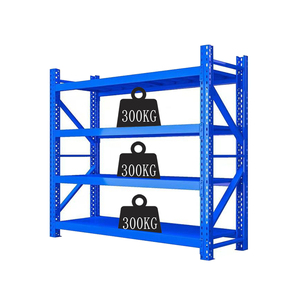
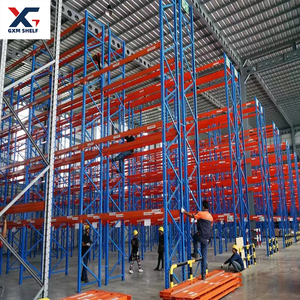
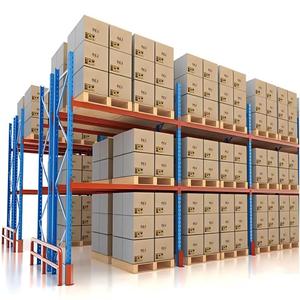
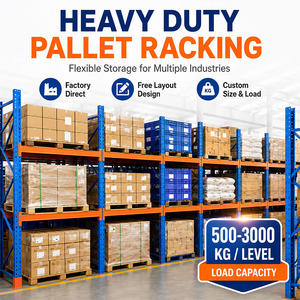
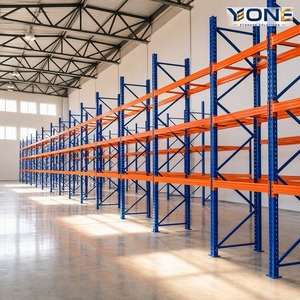
Selective pallet racking remains the backbone of modern material handling due to its 100% direct selectivity for every pallet position. Manufactured using high-tensile cold-formed teardrop or omega (Ω) section upright posts, these systems consist of two primary structural elements: upright frames and horizontal interlocking step beams or box beams.
Beam connection technology utilizes multi-claw connectors with automatic safety locking pins. This geometry prevents accidental beam dislodgement caused by forklift mast errors. Standard beam lengths accommodate 2 to 4 pallets per level (e.g., 2300mm, 2700mm, 3300mm, 3900mm clear entry), with uniform distributed load (UDL) capacities ranging from 1,000 kg to over 4,000 kg per beam pair.
1.2 Four-Way Intelligent Radio Shuttle ASRS Systems
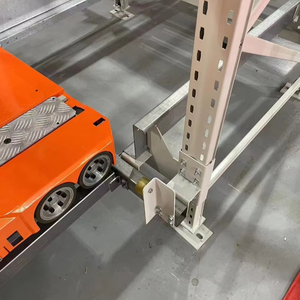
Representing the vanguard of smart warehousing, the 4-way radio shuttle system integrates high-density deep-lane storage with autonomous robotics. The shuttle robot travels along internal racking rails in both X-axis and Y-axis directions, raising and lowering pallet loads automatically.
Key technical components include laser guidance positioning, lithium iron phosphate (LiFePO4) energy modules, wireless WMS/WCS integration via 5GHz Wi-Fi/4G/5G, and high-precision rack rail profiles. Chinese factories manufacture the structural rack rails using continuous roll-forming machines with tolerances within ±0.5mm over 12-meter continuous spans, guaranteeing smooth vehicle transition and minimal wear.
1.3 Heavy-Duty Cantilever Racking Systems
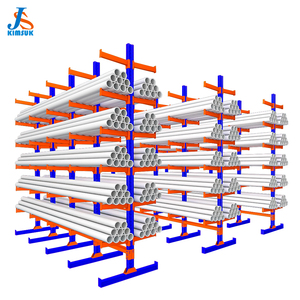
Designed explicitly for loads requiring clear front access without structural vertical columns in the pick face, cantilever racks feature vertical columns welded or bolted to heavy base assemblies, with load-bearing arms extended horizontally.
To carry heavy asymmetric bending moments, upright columns are constructed from hot-rolled H-beams (e.g., UC/UB sections or Q235B/Q355B steel H-profiles). Arms are available with straight or inclined profiles (ranging from 2° to 5°) and are fitted with removable front retainers to prevent cylindrical loads (pipes, tubing) from rolling off.
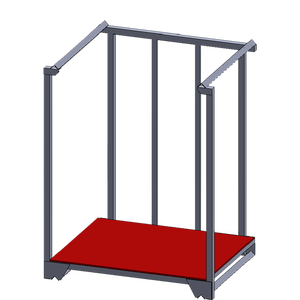
1.4 Modular Stacking Nestainer Racks & Palletainers
Nestainer racks offer dynamic, portable storage that eliminates fixed aisle space. When loaded, nestainers stack up to 4 to 5 units high; when empty, they nest inside one another to reduce floor space consumption by up to 75%. Manufactured from heavy-gauge structural square steel tubing, nestainers distribute weight evenly through inverted corner posts, providing robust structural resistance against dynamic shift during forklift maneuvering.
2. Structural Metallurgy, Manufacturing Tolerances & Seismic Engineering Standards
A critical metric when evaluating Chinese storage rack manufacturers is structural integrity and metallurgical engineering. Premium Chinese factories operate in accordance with strictly defined chemical composition and mechanical stress thresholds:
- Q235B Cold-Rolled Carbon Steel: Yield strength $f_y \ge 235 \text{ MPa}$, Tensile strength $f_u = 375 - 500 \text{ MPa}$. Standard for beams, shelf decks, and general bracing.
- Q355B High-Strength Structural Steel: Yield strength $f_y \ge 355 \text{ MPa}$, Tensile strength $f_u = 470 - 630 \text{ MPa}$. Specified for heavy-duty tall upright frames, seismic base plates, and ASRS structural rails.
In regions subject to seismic activity (such as the Pacific Rim, Andean Seismic Belts, and Southern Europe), structural designs must satisfy dynamic lateral force calculations under codes such as Norma Técnica E.030, FEM 10.2.08, or ANSI/RMI MH16.1. Chinese engineering teams employ 3D Finite Element Analysis (FEA) software to simulate seismic response spectra, dynamic story drift, anchor bolt pull-out forces, and torsional buckling of upright columns.
Additionally, concrete floor slab requirements are integral to safety. Base plates must be secured with chemically bonded or mechanical wedge anchor bolts. The thickness, compressive strength (e.g., C25/30 or 4,000 PSI concrete), and flatness (F-numbers FF/FL) of the floor slab govern total allowable rack height-to-depth ratios (typically capped at 6:1 without auxiliary overhead tied-in bracing).
3. Future Sourcing & Technological Trends in Industrial Storage (2026-2030)
The industrial storage landscape is undergoing a structural paradigm shift driven by e-commerce expansion, labor scarcity, land costs, and ESG (Environmental, Social, and Governance) mandates. When sourcing industrial shelving and pallet racks from China, global buyers should align with the following macro-trends:
3.1 Acceleration toward Automated High-Bay Racking (ASRS)
As urban warehouse land values escalate, horizontal facility expansion is being replaced by vertical growth. High-bay racking systems reaching heights of 25 to 40 meters integrated with Stacker Cranes or 3D Shuttle Matrix systems are experiencing rapid demand growth. Chinese suppliers are supplying entire rack-clad buildings (where the racking system forms the structural frame of the building itself), reducing total construction timelines and capital investment.
3.2 Integration of IoT, RFID, and Smart Weight-Sensing Shelves
Next-generation industrial shelving units are evolving from passive steel structures into active data-generating assets. Embedded weight sensors, RFID reader antennas, and optical LED pick-to-light channels are being direct-integrated into shelf profiles during factory assembly. This enables real-time perpetual inventory audits, automated reordering, and error-free fulfillment.
3.3 Sustainable Sourcing & Eco-Friendly Surface Coatings
Leading Chinese manufacturing hubs have heavily invested in green manufacturing protocols. Solar power arrays installed on factory roofs power roll-forming machinery, while zero-VOC powder coatings and closed-loop wastewater treatment plants for metal pre-treatment ensure compliance with global environmental standards. Overseas buyers can now request carbon footprint documentation for steel raw materials.
4. Total Cost of Ownership (TCO) & Sourcing Optimization Framework
Procuring racking directly from Chinese manufacturers provides significant cost efficiencies, often yielding 25% to 45% savings compared to domestic procurement in North America or Western Europe. However, achieving these savings requires an understanding of the Total Cost of Ownership (TCO) equation:
TCO = Direct Factory Cost (Ex-Works) + Sea Freight & Containerization + Import Tariffs & Customs Duties + Installation & Anchoring Labor + Compliance Certification & Annual Inspection
Key Strategies to Optimize Sourcing ROI:
- Container Packing Optimization: Heavy steel racking components consume container weight limits before spatial volume is filled. Chinese factory export teams utilize CAD container loading software to combine heavy frames with lighter shelf decking, maximizing 40ft High Cube (40HC) container weight capacities up to 26-28 metric tons.
- Modular Standardization vs. Custom Components: Utilizing standard pitch dimensions (e.g., 50mm, 75mm, or 76.2mm teardrop pitch) reduces tool changeover costs and lead times, while guaranteeing easier access to replacement parts during future facility expansions.
- Quality Control & Pre-Shipment Inspection (PSI): Reputable Chinese factories provide internal QA testing reports covering weld non-destructive testing (NDT), coating thickness (microns), and destructive load testing under load-to-destruction testing rigs. Third-party inspections (SGS, BV, TUV) can be seamlessly integrated into LC payment terms.